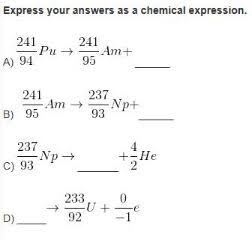

A partial decay series shows a sequence of radioactive changes in which an unstable nucleus transforms into another nucleus through radioactive decay. These problems are common in nuclear chemistry and often ask students to identify missing elements, atomic numbers, mass numbers, or types of decay.
The key to solving a partial decay series is understanding how alpha and beta decay change the nucleus. Once these rules are clear, even a long decay sequence can be solved step by step.
Students may see a series with several known elements and a few blanks. Instead of guessing the missing information, they can use the changes in atomic number and mass number to determine each answer.
What Is a Partial Decay Series?
A radioactive decay series describes the transformation of an unstable atomic nucleus into another nucleus. The process can continue through several stages until a more stable nucleus is produced.
A partial decay series contains only part of the complete sequence. Some information is provided, while other parts are left blank for students to complete.
For example, a question may provide the starting element and the final element but leave one or more intermediate steps empty. The task is to determine what radioactive decay occurred at each stage.
The most common types of decay used in these questions are alpha decay and beta-minus decay.
Understanding Alpha Decay
Alpha decay occurs when an unstable nucleus releases an alpha particle. An alpha particle contains two protons and two neutrons.
Because two protons are removed, the atomic number decreases by 2. The mass number also decreases by 4 because the nucleus loses four nucleons.
The general pattern is:
Mass number: A → A − 4
Atomic number: Z → Z − 2
This rule is one of the most important facts to remember when solving a partial decay series.
For example, suppose an element has a mass number of 238 and an atomic number of 92. After alpha decay, the new nucleus has a mass number of 234 and an atomic number of 90.
The element with atomic number 90 is thorium.
Therefore:
²³⁸₉₂U → ²³⁴₉₀Th + ⁴₂He
The emitted helium nucleus represents the alpha particle.
Understanding Beta-Minus Decay
Beta-minus decay works differently from alpha decay. During beta-minus decay, a neutron changes into a proton while an electron is emitted.
Because a neutron becomes a proton, the atomic number increases by 1. However, the total number of nucleons does not change.
Therefore:
Mass number: A → A
Atomic number: Z → Z + 1
For example, an isotope with mass number 234 and atomic number 90 can undergo beta-minus decay. The resulting nucleus still has a mass number of 234, but its atomic number becomes 91.
The new element is protactinium.
This gives:
²³⁴₉₀Th → ²³⁴₉₁Pa + β⁻
The important point is that beta-minus decay changes the element but does not change the mass number.
The Main Rules to Remember
Before solving a partial decay series, it helps to memorize the basic changes.
| Decay Type | Mass Number | Atomic Number |
|---|---|---|
| Alpha | −4 | −2 |
| Beta-minus | No change | +1 |
These two rules can solve many introductory radioactive decay questions.
If the mass number decreases by 4 and the atomic number decreases by 2, alpha decay has occurred.
If the mass number stays the same while the atomic number increases by 1, beta-minus decay has occurred.
Learning these patterns makes it much easier to identify missing information.
How to Fill in the Blanks
The easiest method is to work through the series one step at a time.
First, write down the mass number and atomic number of the isotope you know.
Next, determine what type of decay is taking place. If the question gives the decay symbol, use that information. If it does not, compare the known isotopes and look at how their numbers change.
Then apply the correct rule.
For alpha decay, subtract 4 from the mass number and subtract 2 from the atomic number.
For beta-minus decay, keep the mass number the same and add 1 to the atomic number.
Finally, use the new atomic number to identify the element.
This approach is more reliable than trying to memorize complete decay chains.
Using the Periodic Table
The periodic table is very useful when solving radioactive decay problems.
Every element has a unique atomic number. Once you calculate the atomic number of a missing isotope, you can use the periodic table to identify the element.
For example, if your calculation gives an atomic number of 88, the element is radium.
If the atomic number is 89, the element is actinium.
If the atomic number is 90, the element is thorium.
The mass number then identifies the particular isotope.
Students should always check both numbers because identifying the element requires the atomic number, while identifying the isotope requires the mass number as well.
A Simple Example
Consider a simplified decay sequence:
²³⁸₉₂U → ²³⁴₉₀Th → ?
Suppose the second step is beta-minus decay.
The mass number remains 234.
The atomic number increases from 90 to 91.
Therefore, the missing isotope is:
²³⁴₉₁Pa
This example demonstrates why keeping track of both numbers is important.
The mass number tells us that the isotope remains at 234, while the atomic number tells us that the element changes from thorium to protactinium.
Working Backward
Sometimes a problem gives the final isotope and asks you to determine what came before it.
The same rules can be reversed.
For alpha decay, the daughter nucleus has a mass number 4 lower and an atomic number 2 lower than the parent. Therefore, when working backward, add 4 to the mass number and add 2 to the atomic number.
For beta-minus decay, the daughter has an atomic number 1 higher than the parent. When working backward, subtract 1 from the atomic number while keeping the mass number unchanged.
This technique is especially helpful when the blank appears before a known isotope.
Checking Conservation of Mass Number
A good way to check your answer is to make sure the mass number changes correctly.
During alpha decay, the nucleus loses four nucleons. Therefore, the mass number must decrease by 4.
During beta-minus decay, a neutron changes into a proton. Since the total number of nucleons remains the same, the mass number does not change.
If your answer produces an unexpected change in mass number, check the calculation again.
This simple check can catch many mistakes.
Checking Conservation of Atomic Number
Atomic number provides another useful check.
During alpha decay, the nucleus loses two protons. The atomic number therefore decreases by 2.
During beta-minus decay, a neutron becomes a proton. The atomic number increases by 1.
The atomic number is also important because it determines the identity of the element.
For example, changing the atomic number from 90 to 91 changes the element from thorium to protactinium.
Common Mistakes
Students often make mistakes when they remember one rule but forget the other.
One common mistake is changing the mass number during beta-minus decay. The mass number should remain unchanged during beta-minus decay.
Another mistake is changing the atomic number by the wrong amount during alpha decay. Alpha decay reduces the atomic number by 2, not 1.
Students may also identify an element using the mass number instead of the atomic number. The atomic number determines the element.
A final common mistake is failing to check the complete sequence. Even if one answer looks correct, it should fit logically with the steps before and after it.
Reading Nuclear Notation
Nuclear notation provides both the mass number and atomic number.
It is commonly written as:
ᴬ_ZX
Here, A represents the mass number, Z represents the atomic number, and X represents the element symbol.
For example:
²²⁶₈₈Ra
The number 226 is the mass number, while 88 is the atomic number. The element is radium.
Understanding this notation makes decay series questions much easier to read.
Identifying Alpha Particles
An alpha particle is written as:
⁴₂He
It is essentially the nucleus of a helium atom.
When a nucleus releases an alpha particle, four units are removed from the mass number and two are removed from the atomic number.
Therefore, if you see helium notation on the product side of a nuclear equation, you can immediately recognize alpha decay.
Identifying Beta Particles
A beta-minus particle is an electron and is commonly represented as:
β⁻
During beta-minus decay, a neutron changes into a proton and releases an electron.
The mass number stays the same because the number of nucleons does not change.
The atomic number increases by 1 because the nucleus now contains one additional proton.
This distinction is essential when filling blanks in nuclear equations.
A Step-by-Step Strategy
When facing a difficult partial decay series, use a consistent process.
Start with the isotope whose information is known.
Write its mass number and atomic number separately.
Next, identify the type of radioactive decay.
Apply the correct numerical change.
Then identify the element using the new atomic number.
Continue the same process until every blank has been completed.
Finally, check the entire sequence from beginning to end.
This method reduces confusion and makes complicated questions more manageable.
Why the Atomic Number Matters Most
The atomic number is the identity of an element.
Every element has a different number of protons. Hydrogen has atomic number 1, helium has atomic number 2, and so on.
If the number of protons changes, the element changes.
That is why alpha and beta decay can create new elements.
During alpha decay, two protons leave the nucleus.
During beta-minus decay, a neutron becomes a proton.
Both processes therefore change the atomic number.
Why the Mass Number Is Different
The mass number represents the total number of protons and neutrons in the nucleus.
Alpha decay removes two protons and two neutrons, so the mass number decreases by 4.
Beta-minus decay changes one neutron into one proton. The total number of nucleons remains unchanged, so the mass number stays the same.
Understanding this difference helps explain why the two decay processes produce different patterns.
Solving Multiple-Step Decay Series
Some questions contain several radioactive transformations.
For example, a sequence might contain an alpha decay followed by two beta-minus decays.
Suppose the starting isotope has:
Mass number = 238
Atomic number = 92
After alpha decay:
Mass number = 234
Atomic number = 90
After the first beta-minus decay:
Mass number = 234
Atomic number = 91
After the second beta-minus decay:
Mass number = 234
Atomic number = 92
The element changes at each beta step even though the mass number remains unchanged.
This example shows why students should calculate each stage separately.
Using a Table to Avoid Mistakes
A table can make a long decay series easier to solve.
| Step | Decay | Mass Number | Atomic Number |
| Starting isotope | — | 238 | 92 |
| Step 1 | Alpha | 234 | 90 |
| Step 2 | Beta-minus | 234 | 91 |
| Step 3 | Beta-minus | 234 | 92 |
This format keeps the information organized.
It also makes it easier to identify an incorrect calculation.
For classroom assignments, creating a small table before filling the blanks can save time and reduce errors.
What If the Decay Type Is Missing?
Some questions do not directly tell you whether a step is alpha or beta decay.
In that situation, compare the mass and atomic numbers of the known isotopes.
If the mass number drops by 4 and the atomic number drops by 2, the step is alpha decay.
If the mass number remains unchanged and the atomic number rises by 1, the step is beta-minus decay.
You can then use the identified pattern to solve the missing isotope.
Using the Final Isotope as a Check
The final isotope can provide an important confirmation.
After completing the series, compare your calculated final isotope with the one provided in the question.
If they match, your calculations are likely consistent.
If they do not match, go back through each step and check the mass and atomic number changes.
This backward check is particularly useful for long decay series.
Tips for Students
Students can improve their performance on these questions by memorizing only a few essential rules.
Remember that alpha decay changes the mass number by −4 and the atomic number by −2.
Remember that beta-minus decay changes the atomic number by +1 while leaving the mass number unchanged.
Always use the atomic number to identify the element.
Write calculations clearly instead of doing them mentally.
Finally, check the complete series after filling every blank.
These habits can make nuclear chemistry questions much easier.
Practice Question
Consider this simplified sequence:
²³⁵₉₂U → ²³¹₉₀Th → ?
If the second step is beta-minus decay, determine the missing isotope.
The mass number remains 231.
The atomic number increases from 90 to 91.
Therefore, the missing isotope has:
Mass number = 231
Atomic number = 91
Atomic number 91 corresponds to protactinium.
So the answer is:
²³¹₉₁Pa
The same method can be applied to longer questions with several blanks.
Another Practice Example
Consider:
²²⁶₈₈Ra → ?
If the nucleus undergoes alpha decay, subtract 4 from the mass number and 2 from the atomic number.
Mass number:
226 − 4 = 222
Atomic number:
88 − 2 = 86
Atomic number 86 corresponds to radon.
Therefore, the daughter isotope is:
²²²₈₆Rn
This example demonstrates the complete process in just a few steps.
The Best Way to Learn Partial Decay Series
Memorizing examples can help, but understanding the rules is much more useful.
Once you know what happens to the mass number and atomic number during each decay process, you can solve unfamiliar questions without memorizing every possible decay chain.
Practice is also important.
Try solving short examples first. Then move on to longer sequences containing several decay steps.
When an answer is incorrect, identify which rule was applied incorrectly rather than simply memorizing the correct answer.
This approach builds a stronger understanding of nuclear chemistry.
Final Thoughts
A partial decay series becomes much easier once the basic nuclear decay rules are understood. Alpha decay reduces the mass number by 4 and the atomic number by 2, while beta-minus decay leaves the mass number unchanged and increases the atomic number by 1.
The best strategy is to work through each step carefully, record the mass and atomic numbers, and use the periodic table to identify missing elements. Checking the final sequence can also help catch calculation errors.
With regular practice, students can confidently fill in missing parts of radioactive decay series and solve nuclear chemistry problems more efficiently.